
Practical guides
How to Identify Japanese Pokémon Cards and Find Their Counterparts
Identify Japanese Pokémon cards using their names, sets, numbers and language, then understand what a confirmed English counterpart tells you.
To identify a Japanese Pokémon card, record its name, set, collector number and printed language together. Then look for a confirmed regional counterpart. A translated name helps you recognize the card, but it does not establish an equivalent printing by itself.
Keep the Japanese card’s identity intact when you find a match. Its English counterpart may have a different set name and collector number, and the relationship alone does not establish matching artwork, finish or price.
Read the translated name without changing the printing
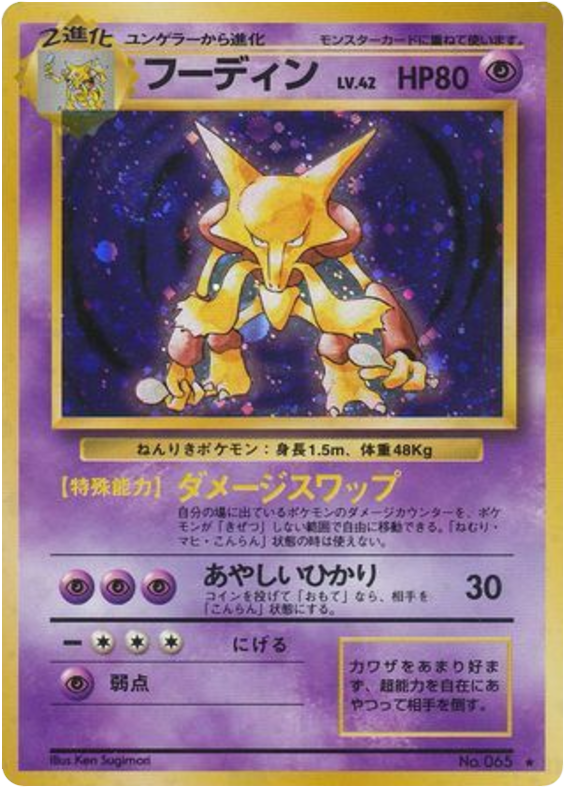
Alakazam (フーディン) from Expansion Pack (拡張パック), No.065, is a Japanese card. “Alakazam” is the supplied readable display name; using it in your collection notes does not make the card an English printing.
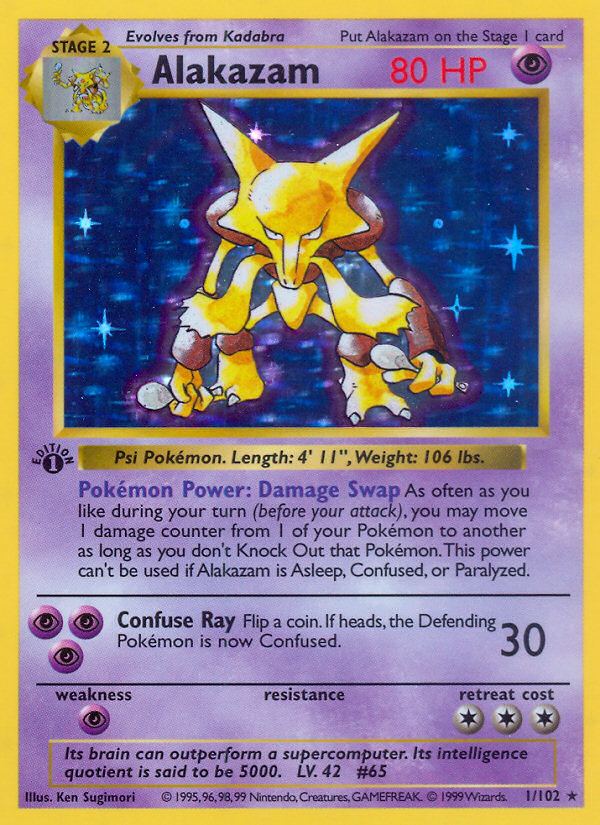
Its confirmed English counterpart is Alakazam from Base, numbered 1/102. That gives you a useful connection between the cards while preserving their separate identities. Record Expansion Pack for the Japanese card and Base for the English card rather than replacing one set name with the other.
Compare confirmed counterparts
Compare each Japanese card’s set and number with those of its confirmed English counterpart below. Alakazam, Mewtwo and Nidoking show why you should retain both identities instead of expecting the same collector number across languages. These examples establish the listed relationships, not a matching rule for every Japanese card.
| Japanese card | Japanese set | Japanese number | English card | English set | English number |
|---|---|---|---|---|---|
| Alakazam (フーディン) | Expansion Pack (拡張パック) | No.065 | Alakazam | Base | 1/102 |
| Mewtwo (ミュウツー) | Expansion Pack (拡張パック) | No.150 | Mewtwo | Base | 10/102 |
| Nidoking (ニドキング) | Expansion Pack (拡張パック) | No.034 | Nidoking | Base | 11/102 |
For another card, leave the counterpart unresolved until you have a supported relationship. The same Pokémon name or an appearance in another card’s artwork is not enough. A cameo identifies an appearance within artwork; it does not establish equivalent cards or connected illustrations.
A practical identification checklist
- Keep the card’s printed language explicit, even when using a translated display name.
- Record the set and collector number alongside the name.
- Check the full matching card record rather than accepting a Pokémon-name match alone.
- Record a confirmed counterpart separately, keeping its own language, set and number.
- Leave artwork, finish and price comparisons open unless you have evidence for those specific details.
Continue the search in Acorn TCG
Acorn TCG supports identifying Japanese Pokémon cards with the iPhone camera, as well as browsing, searching and collecting Japanese cards alongside Western cards. The card-language filter offers Western, Japan and All, helping you focus your search. Review the matching card: identification is not guaranteed for every card and does not authenticate it or assign a professional grade.
When matching relationships are available, Card Detail can show Other Printings and a Japanese equivalent or Western equivalent. Use that connection to investigate a counterpart while keeping the Japanese printing’s own details in your collection. An absent relationship leaves the counterpart unconfirmed.
The card data used in this guide comes from the Acorn TCG catalogue.